
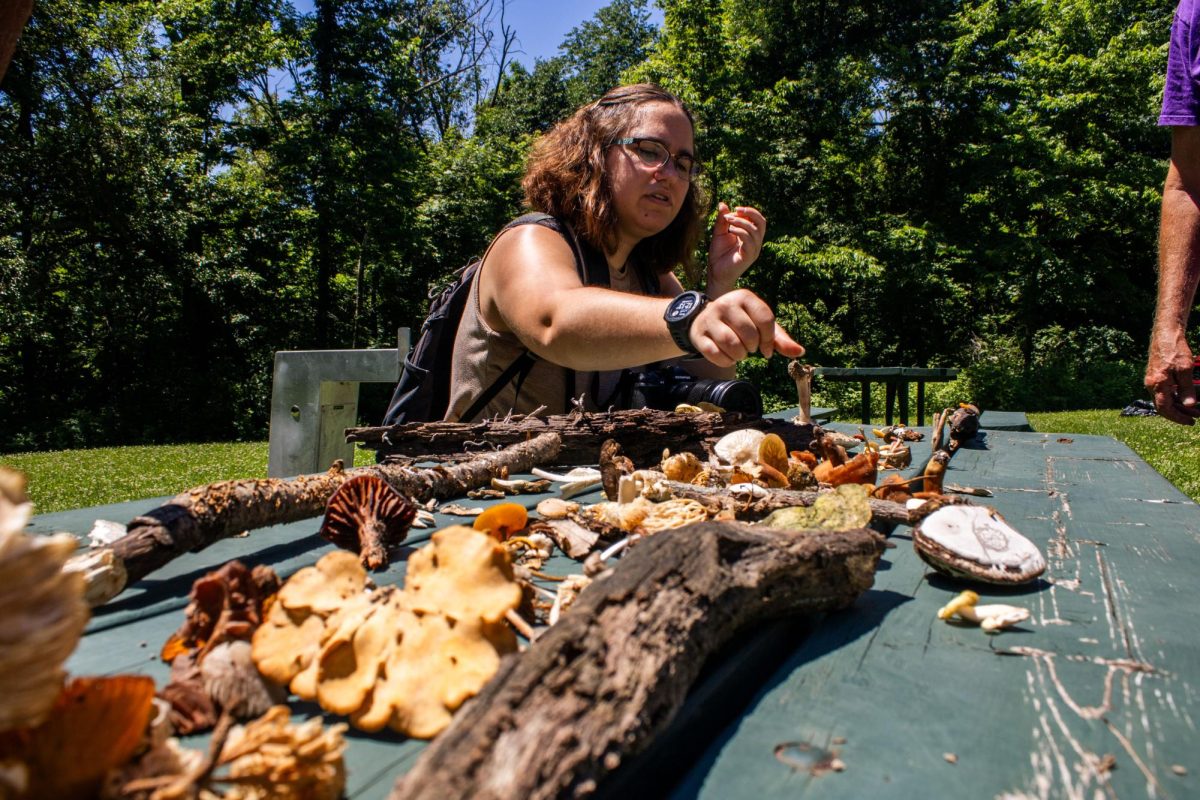
Just a short drive west on Highway 30, the Palisades-Kepler State Park offers an abundance of natural wonders to those needing a quick retreat. Whether swimming or hiking, the park offers 840 acres of wilderness to enjoy, but what many people might fail to notice are the small pieces of fungi that dot the forest floor. That’s what Prairie States Mushroom Club and Friends of Palisades-Kepler were hoping to draw more attention to with a mushroom foray Saturday, June 20.
The foray met at the Cool Hollow Trail, free and open to all, with an emphasis on educating those about the importance of responsible cultivation and appreciation of biological diversity where mushrooms grow.
“It was really useful for me because the people in the mushroom club are so wonderful and eager to share their knowledge,” said Sarah DeLongDuhon, who started going on mushroom forays back in 2017, and has since pivoted her career to focus on what she learned from the club all those years ago. “I got a master’s at the University of Iowa studying mushrooms, and I was pretty much the only person doing research on mushrooms in the state.”
Now the president of the Prairie States Mushroom Club, DeLongDuhon says that outreach to other nonprofits and community organizations like Iowa County Conservation and the Iowa DNR have boosted demand from local parks organizations, like Friends of Palisades-Kepler State Park.
“Part of it is just getting people out here, and just seeing that there’s more than just hiking the trails or going to the sand bar,” said Melissa McGuire, who is a board member with Friends of Palisades-Kepler State Park, and one of the attendees on Saturday’s foray. “Even just in the first 10 feet of the trail we found how many different types, and yeah, it’s been really fun.”
The Pal is in no shortage of mushrooms. Whether growing out of the ground, or from the side of a dead log, it was difficult to walk more than ten paces without spotting a new variety. Part of the event also focused on the consumption of mushrooms.
“I think I’ve got a list of 35 different ones that I’ve eaten.”
That’s Marty Augustine, a long time member of the club, and an experienced forager. He shares that there are many more edible varieties of mushrooms than just the popularly known true morel mushrooms that come out in the spring. “Pheasant back, oyster mushrooms, both native and non native, and gyomitra, which are commonly known as false morel.”
The club takes their time to walk off trail and identify each new variety that they find. They also emphasize however, that you should never eat a mushroom without confirming with an expert that it is an edible variety.
Touching a mushroom? That’s safe, with some members of the mushroom club even biting and spitting out a small piece of a mushroom to verify through taste, what type it is. As long as an unknown mushroom is not ingested, a forager does not have to fear any negative side effects.
“We’re in the business of educating and keeping people safe,” said DeLong Duhon. The club actively works with local parks across the state, and plans to continue leading forays and growing its membership.