
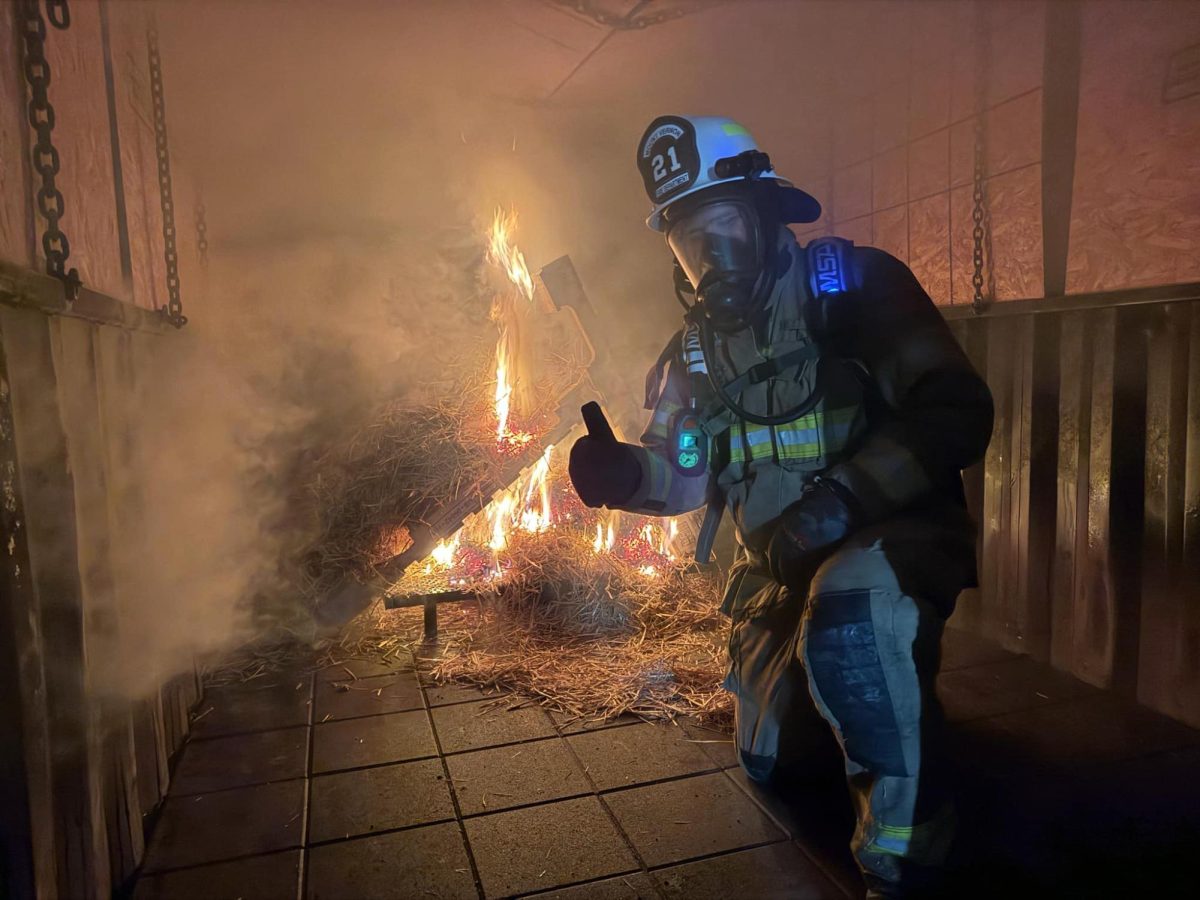
The long days of volunteering and weekends away from family are winding down for Jacob Buster, member of the Mount Vernon Fire Department. Those hours were spent getting the fire department’s training site on Bryant Road ready to open.
“I really have to thank my wife, in-laws and family for their help and patience as we’ve worked on this project,” Buster said.
On Monday, Nov. 24, members of the Mount Vernon Fire Department were holding their first training at the location. Members navigated their way through layouts of kitchens and bedrooms as smoke and heat infiltrated containers.
According to Mount Vernon Fire Department chief Nate Goodlove, this is a way to replicate conditions that officers might see in a house they respond to in a controlled condition.
“If anyone is having trouble, we have the ability to turn on hoses and reset the rooms,” Goodlove said.
As well, the rooms in both the clean room and the containers containing heat and smoke are able to have their furniture rearranged if officers are ever getting too used to the room in general.
The first phases of the project have been constructed with proceeds from the pancake breakfast meals, as well as bequests from wills for the project, and contributions from the city and the rural fire district to support the training center.
And countless hours of support and in-kind donations and volunteer man hours from members of the fire department, including help in pouring the concrete slabs.
“Testers Drainage Service placed the containers we’re using for both the clean and hot rooms,” Goodlove said.
The center is allowing the department to do more aggressive trainings and get experience of what conditions might be like in a burning house, again from a controlled environment.
Mehrdad Zarifkar, member of the fire department and treasurer of the Mount Vernon Volunteer Fire Fighters Association (MVFFA), the non-profit group, said there’s a door on one of the containers where firefighters can practice breach entries into a fire site.
And for a volunteer fire department like Mount Vernon, this facility is one that sets them apart.
Goodlove said that when it comes time to replace the containers due to their use or damage, that can easily be done and they are the cheapest part of the site to replace. The most expensive piece was the concrete pad that makes up the site, and the boxes should last a good 10 years before they need to be updated again.
And the site has proven to be a place to help the department talk to cadets about what they might expect at scenes in the future.
Tim Keegan, member of the fire department and MVFFA, said he has been a volunteer firefighter for 20 years.
“And tonight as we were doing this practice, I learned something that I’d been doing wrong,” Keegan said. “Things are constantly changing when it comes to firefighting techniques, and this is a safe environment for us to learn or relearn skills before we need to be using them on real fires.”
Firefighters Monday evening were doing a fire rescue demonstration, where dummies were placed at random in the room by one of the trainers running the center and then groups of three used their skills to locate and rescue them.
Keegan said the other thing that’s great about these facilities, especially the smoke and heat rooms, is it helps members know what their limits are in a real fire.
“It tests you and your training to remember what you should do in these situations,” Keegan said. “Things like remembering to slow down your breathing, rely on your senses. Those old school firefighting techniques that are important.”
“Seeing this all come together thanks to our community has been amazing,” Buster said.
And Buster knows that neighbors nearby the facility may encounter smoke as they’re training.
“We’re burning wooden pallets, hay and straw for the most part in this,” Buster said. “We like those materials because they give that thicker black smoke you might encounter in fires, but they’re also mostly a clean material to be burning.”
All those who have worked on this project wanted to thank the businesses and people who helped make this project a reality for the low price tag they are spending on the facility.
“Without the donations and volunteer contributions we had to this project, this easily could have been a $1 million to $1.5 million project,” Zarifkar said.
There’s a third building that is waiting to be constructed, hopefully still this winter, that will help protect gear on site.
And Buster is wanting to roll this out to other departments to see this spring and potentially get their own training experiences in.