
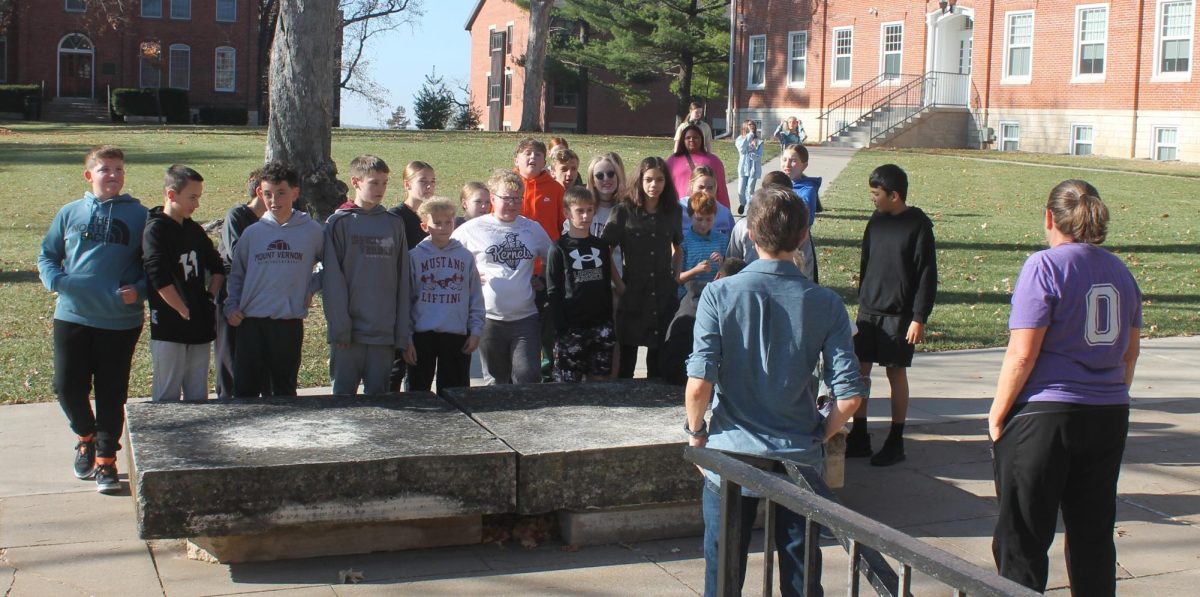
Cornell College may be on block break at the moment, but that didn’t stop students from learning on campus. Students from Dee Winder’s sixth grade science class made a tour of Norton Geology Center on Cornell College’s campus to reiterate some of the things they’ve learned in earth science units, as well as previews of some items yet to come.
Emily Walsh, professor of geology at Cornell College, lead the tour.
“What does geology study?” Walsh asked at the beginning of the tour.
Answers included rocks, fossils, landforms, hills, lakes, ponds, rivers and minerals.
Students then got their first stop inside the museum, where the age of Earth was discussed. Walsh shared a couple samples of meteorites for students to lift and look at.
“How are we able to determine the age of the Earth due to studying items like meteorites?” Walsh asked.
The answer was by studying the stardust apparent in meteorites, as they would have been in existence as long as the Earth may have been, and by determining the age of the rocks, we can determine its age in relation to Earth.
Walsh said like Earth’s core, the core of most meteorites has iron in it.
“We’re not able to get to the Earth’s core ourselves, due to multiple layers of the Earth,” Walsh said.
Students noted those layers are the inner core, outer core, mantle and crust.
Walsh then gave students a bit of an early lesson on plate tectonics, a portion of the unit they haven’t fully explored in school. Continents of the earth float over portions of the mantle, which is comprised of hot rocks.
“How do we get the oceans, like the Pacific?” Walsh asked.
Students explained that as continental plates drifted apart from one another, that has given water an opportunity to fill those spaces.
There are areas along fault lines or where two tectonic plates rub against one another that cause either volcanic releases or earthquakes when they collide.
After that, on the first floor of the museum, students were encouraged to search for items including:
A stratographic column of Iowa
Fossilized burrow
A Rams horn fossil
Franklinite
A rock ripple
A shark with a weird jaw
When sabretooth cats were on Earth
Then, students went to the second floor, where they got to look at the three different type of rocks – sedimentary, igneous and metamorphic.
When it came to where items like fossils are found, those are usually discovered in the sedimentary level of rocks.
Igneous rocks usually have bubbles that denote their exposure to heat.
Metamorphic are rocks that might have been another type of element that have been changed due to heat and pressure underground.