
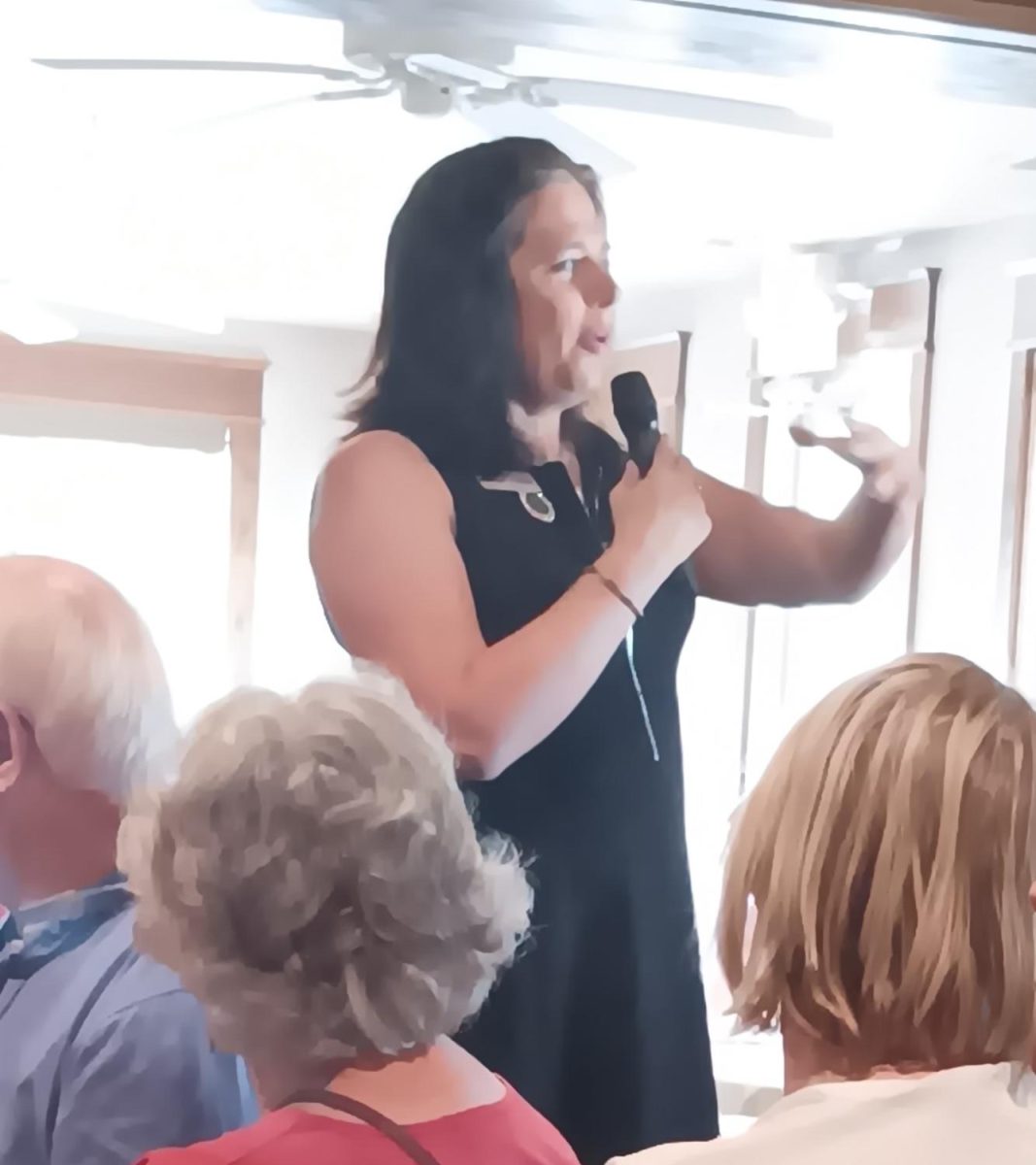
Aime Wichtendahl, House Representative for District 80, spoke at Voices United of Rural Linn County’s meeting Wednesday, Aug. 27, about LGQBTIA+ issues.
Wichtendahl’s political career all started because of getting a tattoo in Hiawatha.
Aime Wichtendahl, the first openly trans-women serving in the Iowa legislature, started her tenure in politics because of a local issue.
“The tattoo parlor was talking about the efforts that were being made to kick them out of the community, and I couldn’t understand why anyone would want to turn away a good tax revenue for their community,” Wichtendahl said.
That started her run for Hiawatha City Council, collecting the signatures to get her name on the ballot.
“The one thing I know about me is I’d rather try and fail at something, then not try at all,” Wichtendahl said.
She ran as a voice of the people, and worked as a city council member to do what the people of Hiawatha elected her to do.
Wichtendahl was open in her speech that she knew from a very young age that she didn’t identify as the gender she was born as, knowing at the age of 9.
“I pushed that down for 15 years,” Wichtendahl said. “The thing with pushing something like that down for so long, is that it will still cut at you like a cancer.”
After graduating college, she spiraled with depression and alcoholism.
“At the time where I had a new career, a wife and child, living the idyllic dream for a lot of people, I couldn’t contain it anymore,” Wichtendahl said. “I was watching my young kid playing, and I couldn’t get myself off the couch to play with my son.”
Wichtendahl made the decision to live so she could see him grow up and start the transition process.
To any youth, that was a point she wanted to make – transitioning and being true to herself and her identity made her life instantly better.
“I was no longer living with others’ expectations on myself, I was living my honest life,” Wichtendahl said.
Wichtendahl was elected to the Iowa House in 2024, serving in House District 80.
For Wichtendahl, every bill that targets LGQBTIA individuals in the state is a failure for many across the state.
“They’re bills that aren’t addressing the issues impacting the lives of many Iowans in a meaningful way,” Wichtendahl said. “Every session since 2021, though, we’ve seen at least one of these divisive bills enter the session.”
That culminated this year with the bill that passed and stripped protections of gender identity from the Iowa Civil Rights.
During question and answer, Wichtendahl said that a lot of the bills targeting LGBQTIA+ individuals are coming from right-wing groups, including Focus on the Family and the Family Leader, and are usually used in concert to pass a different piece of unpopular legislation.
“The oldest trick in the playbook is the “look over there” play,” Wichtendahl said. “While people are outraged on this bill focusing on a minority, they’re passing a bill that erodes something else.”
What pushes those bills along are constituents who are frustrated because of a lack of reinvestment in their small communities and blaming others for those issues.
“It isn’t members of the trans community, the immigrant communities, or others who are at fault,” Wichtendahl said.
Wichtendahl also said the Iowa Department of Government Efficiency task force is nothing but a sham. With 14 Republicans and one independent on the commission, it doesn’t represent the majority of Iowans.
“My worry isn’t that they will outright end IPERS, but they’ll end up doing something catastrophically stupid that impacts IPERS moving forward,” Wichtendahl said.
As for bills she is looking forward to in the coming legislative session, she is hopeful her bill on artificial intelligence and allowing for people to opt-out of inclusion with the technology moves further along.
She knows that property tax reform will likely be the big bill the legislature tackles this year.
An attendee asked how to get water quality as an issue that is seen as more important to the legislature.
Wichtendahl said continued momentum and grassroots movements to push the issue higher in the minds of all Iowans is important.
“Make sure your legislators know this is a priority for you, and one that will bring you out to vote,” Wichtendahl said. “It doesn’t rise as one of the top issues for many legislators because not as many people are advocating for it and they’re concerned on taking on the farm lobby.”
When asked about her advice to young LGQBTIA individuals – Wichtendahl said finding your people and where you are accepted is important.
“I know things are hard right now in this state, that the environment is terrible,” Wichtendahl said. “But I’m always an optimist it’s going to get better.”
She recounts that the 1980s and 1990s were horrible times for individuals to be out, but those who were made things better for those who followed.
As for how she has weathered the environment at the capital that is hostile towards her, Wichtendahl said she is an extremely stubborn person and will continue showing up and doing her job.
The week preceding the repeal of gender protections from the Iowa Civil Rights act was the toughest thing she has had to deal with in the legislature.
“There was no way I was going to remain silent on this issue, no matter how much it hurt,” Wichtendahl said.
She said it was hard not to take that repeal personally as well.
When it came to the importance of communicating to legislators, Wichtendahl said calling was more effective than emailing, but just letting your legislator hear from you on any issue was important.