
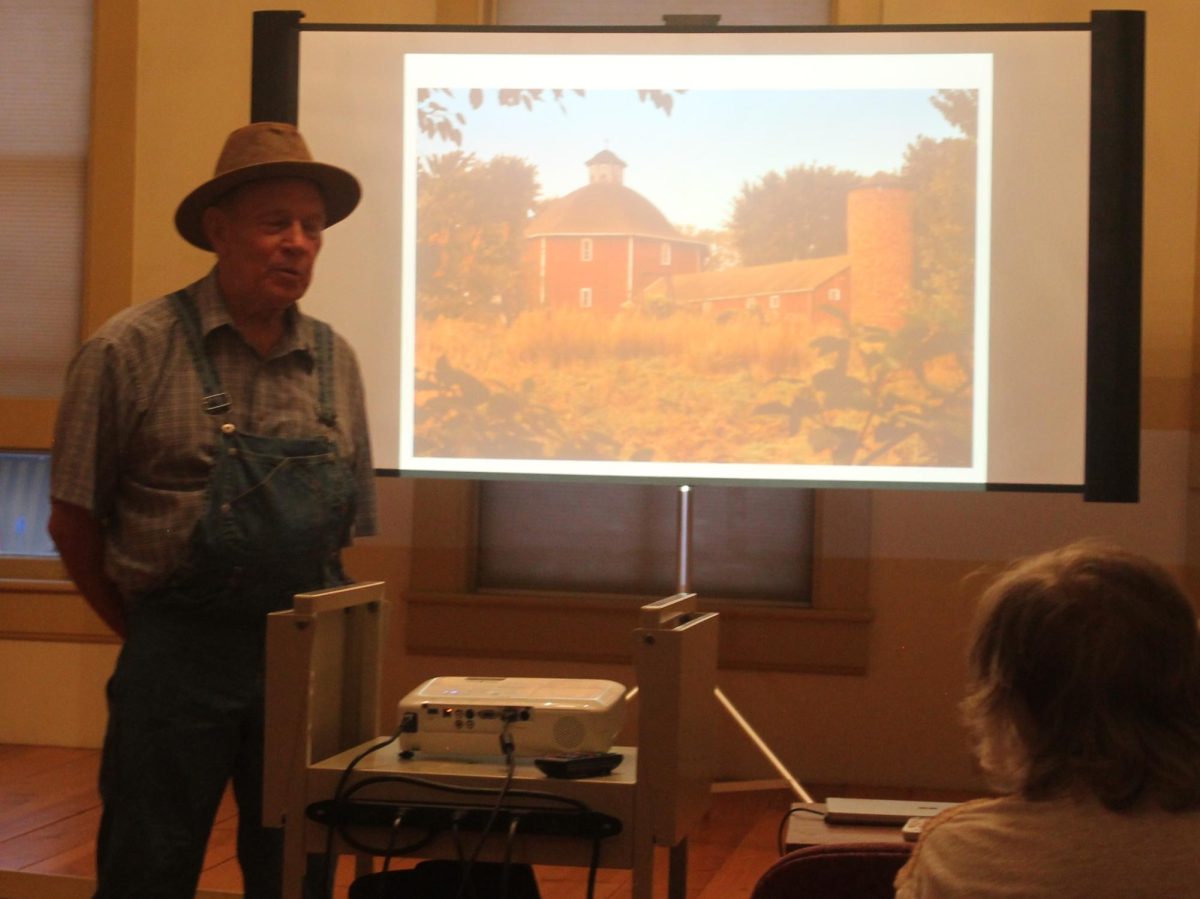
Rich Tyler was not someone who knew about preserving old barns before purchasing a property with one more than 30 years ago.
Tyler knows more about auditory issues.
But he was also one of the first to say the project he embarked on helped him form new friendships and learn about a historic property.
“I think it’s important to preserve these old buildings so we know where they came from,” Tyler said.
Tyler’s presentation was part of Humanities Iowa, and sponsored by Friends of the Lisbon Public Library, Lisbon Historic Preservation Commission and Pleasant Grove Heritage Park. Members of Historic Barns of Iowa were also in attendance.
Tyler worked on restoring the Secrest Barn in Downey, Iowa more than 30 years ago.
The Secrest Barn was originally built in 1883, and was one of the largest octagonal barns in Johnson County at the time.
The barn was owned by Josh Secrest, a farmer who had more than 500 acres of farmland at one time. The barn was able to house 32 horses, 16 cows and several thousands of pounds of hay.
The barn had three levels – the ground level was where the horses and cows resided when they weren’t in the pastures. The middle level stored hay that could be thrown down to the animals below to help feed them. The upper level stored more hay bales that could be moved to the middle level through the fall and winter as needed.
Secrest farmed on the property up until 1893, when he retired and moved into Iowa City. His sons took over the farm shortly after and the family kept the farm up until the Great Depression
The barn was built by Frank Longerbean who moved to Iowa in 1859.
When it came to the construction of the barn, the lumber had to come from northern states and floated down the Mississippi River.
“The lumberyard that Longerbean would have used was based in Muscatine,” Tyler said.
One of the things that made the octagonal barn interesting was the use of laminated wood that comprised the beams for the interior.
In 1992, Tyler bought the property.
“At the time, there were a number of trees that were close to the barn,” Tyler said. “As well, we also had some of walls that were bowed out, as the berm at the bottom of the barn had pushed into the foundation.”
One of the first important steps for the barn was addressing that dirt that was pushing into the foundation.
One of the other steps was getting the foundation pillars elevated out of the concrete that had been poured around them.
“That was allowing moisture to get to those beams,” Tyler said. “By pulling them out of the ground and resting on concrete, that helped stabilize the barn.”
Tyler worked with a structural engineering firm which did other stabilizing work to the barn, including reinforcing some of the supports throughout the octagonal barn to correct the number of walls bowing out.
Another important step was fixing the roof of the barn, which had a number of shingles which had went missing over the years.
All of that work required the help of volunteers, which Tyler said accounted to more than a thousand hours of time working on the barn. Those included students from Cornell College and the University of Iowa.
Tyler also received numerous grants throughout the project as he restored the historic barn to its new use.
Tyler now uses the barn as an events venue, including for weddings, and the building is open for people to tour every day. The building will also be part of the statewide historic barns tour in September this year.
Tyler has hosted a number of classes on restoring barns there for more than a decade.
Tyler said that the importance of many barns is the architecture of the barns and how they were constructed as one of the reasons to preserve these historic barns.
He said there used to be a smaller octagonal barn roughly a mile south of the Secrest barn in Johnson County but that barn was burned down.